Linda Melvern is a widely published investigative journalist and author. She is an Honorary Professor in the Department of International Politics, University of Wales, Aberystwyth. A consultant to the Military One prosecution team at the International Criminal Tribunal for Rwanda, part of her archive of documents is used to show the planning and progress of the 1994 genocide. Linda Melvern has written six books of non-fiction and is widely published in the British press and academic journals. She is the second vice-President of the International Association of Genocide Scholars.
Her previous books include The Ultimate Crime (Allison and Busby, 1995) which traces the secret history of the UN’s first fifty years and became the basis of a TV series for Channel Four, the three- part “UN Blues” broadcast in January 1995. “A People Betrayed. The Role of the West in Rwanda’s Genocide”, (Zed Books, 2000), now in its sixth impression, is widely used as source material by students in universities world-wide and was described as “the best overall account of the background to the genocide, and the failure to prevent it...the investigation is hers, and hers alone. She discovered so much that we did not know”. Lt-.General Romeo Dallaire, Force Commander, UN Assistance Mission for Rwanda, (UNAMIR) 1994.
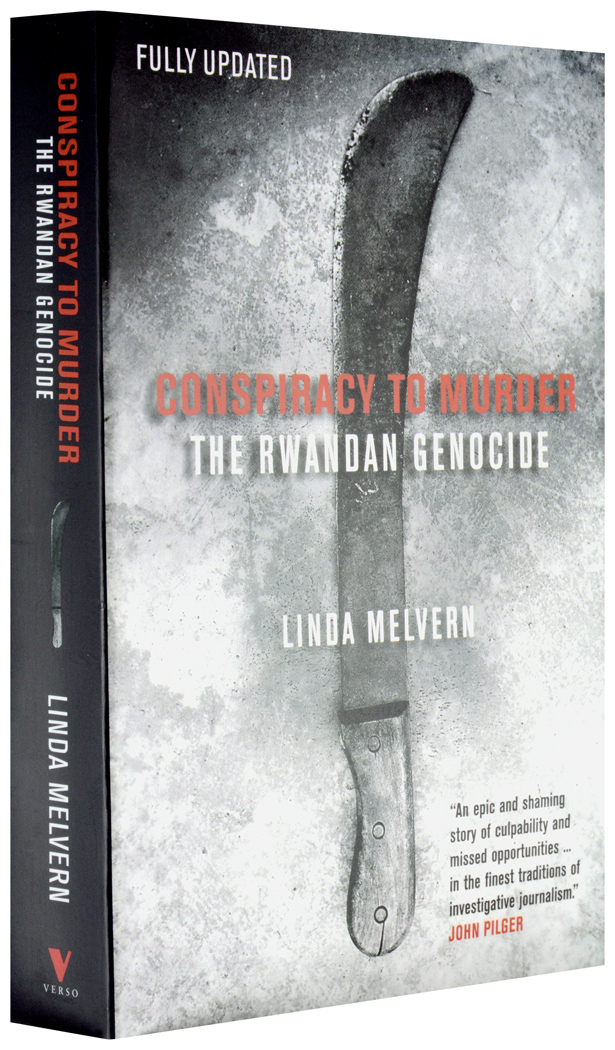
The 1994 genocide in Rwanda is a milestone event of twentieth century. The book reveals the extent of the planning of the genocide and its progress country-wide.
The book contains the first comprehensive reconstruction of the genocide together with exclusive information about French foreign policy towards Rwanda – the role of its intelligence services and its mercenaries.
Conspiracy to Murder also contains the details of intelligence reports from three countries – the US, Belgium and France -- about the missile attack which on April 6, 1994, killed two African Presidents in the skies over Kigali.
The author had unique access to files and records that were abandoned by the genocidaires, many of these documents from the previous regime’s department of military intelligence. These documents give a unique insight into the minds of the conspirators and how they determined that genocide and the racist policy that underpinned it should become a part of government policy.
A shocking indictment of those who knew what was happening and chose not to intervene.
The crime of genocide is the most serious crime against humanity, and its prevention the single most important commitment of the countries who join together as the United Nations. The Security Council of the UN is central to the application of the 1948 Convention on the Prevention and Punishment of the Crime of Genocide. Genocide is a deliberate policy to reconstruct the world. In order to commit genocide a group of people must make an agreement requiring a concerted plan of action.
In Rwanda in 1994 up to one million people were murdered as a result of a deliberate government policy, designed in advance and carried out according to an explicit strategy. What happened in Rwanda is a milestone event of the twentieth century and it deserves precise documentation. Conspiracy to Murder explains how this genocide was planned and perpetrated and who was responsible.
The idea behind a second book on the genocide was to examine more extensive material and a wide-range of new information obtained after A People Betrayed was published in 2000. This new material, upon which a great deal of this book relies, gives a unique insight into the minds of the genocide conspirators. In the Rwandan capital, Kigali, I gained privileged access to files and records that were found when the Rwandan government army abandoned the city. These neatly typed letters, memoranda, reports and other documents, all written in French, filed neatly in ring-binders, show evidence of the planning of genocide. These include documents from the records of the interim government whose cabinet members perpetrated the genocide.
The information in the book also includes material obtained from the International Criminal Tribunal for Rwanda (ICTR). The evidence produced in court by a series of prosecution witnesses, together with a documentary trail, indicates an import link between a group of colonels in the army hostile to the peace agreement, and certain Rwandan politicians who were determined to resist the path of democracy.
A picture of how the genocide was perpetrated comes from the confession of the prime minister in the interim government, Jean Kambanda. It is Kambanda who enters the history books as the first person in an international court to plead guilty to the crime of genocide. His 1,800-page interrogation has not yet been made publicly available by the ICTR. It is a remarkable document in which Kambanda describes how Rwanda’s full state apparatus was used to carry out the killing.
In Kigali there are soldiers from the former Rwandan government army who provided me with information and I obtained valuable accounts from interviews conducted with category one genocide convicts who have been sentenced to death by Rwanda’s national courts. The 2006 paperback edition includes a new chapter to include the first written account of the seventeen day testimony of Colonel Theoneste Bagosora, who is accused of having taken control in a coup as the genocide began.
At the UN Secretariat in New York I was allowed to study the records of the Department of Peacekeeping Operations (DPKO), the decision to grant access to these records provided by the Secretary General, Kofi Annan. The documents include the twice daily reports sent to UN headquarters while the genocide progressed. This archive must be one of the world’s most extraordinary collections.
Buy Conspiracy to Murder
Verso Hardback 2004
Revised paperback 2006
ISBN 1-84467-542-4
Bibliography
Reviews